
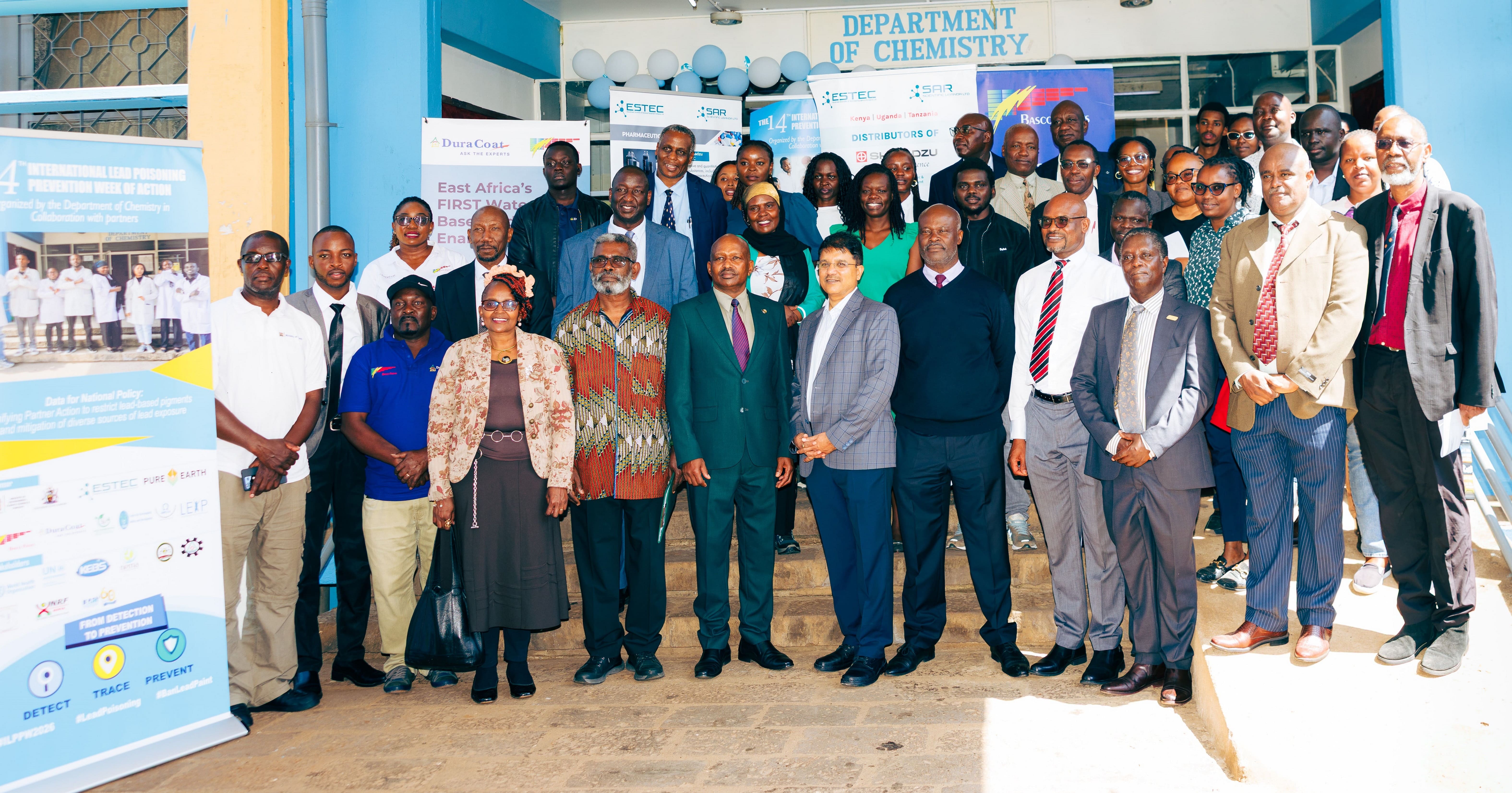
NAIROBI, KENYA – Friday, 23rd October 2026 – The University of Nairobi held the 14th International Lead Poisoning Prevention Week of Action (ILPPWA) at its Chiromo Campus. The week-long event, themed "From Detection to Prevention," ended with a high-level ceremony that included the official commissioning of the University's Exposure Science and Chemometrics Laboratory (ESCL) and the presentation of key national policy briefs titled "Moving from Detection to Prevention of lead-based pigments in Paints to mitigate lead Exposure in Kenya."
Serving as Chief Guest, H.E. Dr. Joyce G.N. Kithure, Spouse of the Deputy President of the Republic of Kenya, urged a swift shift away from simply detecting lead contamination toward actively preventing exposure, especially among vulnerable children. She called on government agencies, researchers, and industry leaders to turn scientific findings into practical, enforceable measures, stressing that public safety is a shared duty that demands strong public education and regulatory enforcement.
The upgraded ESCL was officially commissioned by Dr. Eng. Festus K. Ng'eno, Principal Secretary for Environment and Climate Change. In his remarks, he emphasized that national efforts must move upstream to keep hazardous raw materials like lead chromates out of domestic supply chains. He highlighted a landmark University study led by Dr. Faridah Were, which found that 88 percent of sampled yellow road-marking paints exceeded Kenya's legal limit of 90 parts per million (ppm), reaching as high as 186,000 ppm. In response, the government is working to create dedicated customs codes for lead chromates and to co-sponsor African proposals under the Rotterdam Convention.
Speaking on behalf of the Vice-Chancellor, Prof. Eng. Ayub N. Gitau, the Deputy Vice-Chancellor (Human Resources and Administration), Prof. Leonida, emphasized that detection is only the beginning. She noted that the new laboratory will enable the University to carry out independent analyses, produce credible local data, and train future analysts through Competency-Based Education and Training (CBET).
The event attracted distinguished leaders from the National Environment Management Authority (NEMA), the Kenya Bureau of Standards (KEBS), the National Research Fund, UNEP, the Directorate of Multilateral Environmental Agreements, and Nairobi County's health services.
On behalf of the Faculty of Science and Technology, Acting Dean Prof. George Ongamo reaffirmed the faculty's dedication to ensuring that scientific research directly benefits society and shapes enforceable policy. The Department of Chemistry was represented by Acting Chairperson Prof. Damaris Mbui, who added that academic data becomes truly meaningful when it supplies the empirical basis for upstream policy interventions.
In her opening remarks, the Acting Chairperson, Prof. Damaris Mbui, noted that for decades, scientific literature had documented the severe public health risks associated with heavy metal toxicity, particularly the irreversible neurological impact of lead on developing children and exposed workers. She added, however, that laboratory data alone was incomplete if it remained confined to academic publications. She stated that day marked a historic turning point in the national chemicals management agenda, as they were actively connecting rigorous academic research directly to enforceable public policy, border controls, and industrial manufacturing standards.
Prof. Mbui said that the Department of Chemistry took immense pride in leveraging evidence-based solutions for the nation, and she wished to commend and appreciate their outstanding academic and technical staff, whose tireless commitment to excellence, research supervision, and laboratory analysis drove their success every single day. She explained that the extensive research conducted by Dr. Faridah Were and her team, which had highlighted significant non-compliance in yellow road-marking paints and residential oil-based formulations, provided the empirical foundation for the national policy brief being handed over that day. She emphasized that by focusing their collective intervention upstream on raw lead-based pigments, they eliminated toxic contamination before it entered domestic supply chains.
She acknowledged that their progress had been made possible through strong multisectoral collaboration. She expressed appreciation for the partnership of global environmental health organizations, particularly Pure Earth, for their analytical equipment grant support, alongside Vital Strategies, the University of Washington, CEJAD, and industry leaders like Basco Paints, who had demonstrated that a lead-free transition was entirely viable. She added that they were equally proud to see active participation from the University of Nairobi Chemistry Students Association (UNCSA), representing the next generation of scientific champions.
Prof. Mbui explained that the day's program was structured into three clear pillars: the laboratory commissioning they had just witnessed, the formal policy handover and partnership statements during that opening assembly, and an interactive afternoon technical session to address regulatory enforcement, trade flow data, and safe alternatives. She concluded that the University of Nairobi remained committed to serving as the scientific anchor for national chemical safety, environmental protection, and sustainable policy implementation.
Dr. Faridah Were, overall coordinator of the Week and ESCL Research Group Leader, described the collaborative upgrades that transformed the laboratory. Enhanced through contributions from ESTEC and BASCO Paint Products, the facility will be equipped with advanced instruments: from Pure Earth, a Type I ultrapure water purification system, a laboratory hybrid fume hood with rooftop ducting, and a clinical specimen freezer; from Vital Strategies, a microwave digester; and from the University of Washington's Lead Exposure Intervention Project, an X-ray fluorescence (XRF) analyser. Dr. Were presented the Executive Summary and Policy Recommendations to the Principal Secretary's representative, noting that further studies have found elevated lead and chromium levels not only in road-marking paints but also in yellow, green, and red oil-based residential paints, pointing to lead chromate pigments.
Speaking for Pure Earth, East Africa Director Mr. Firew Kefyalew Mekonnen underscored the enormous global scale of the crisis, noting that as many as 800 million children worldwide have harmful blood lead levels. He stressed that Pure Earth is committed to addressing pollution in low- and middle-income countries by identifying where people—especially children—are exposed and working with governments, industry, and communities to stop it. He explained that when measuring lead at parts per billion, ordinary laboratory water contains enough metal to distort results, making ultrapure water essential; the fume hood protects technicians from hazardous acid vapors; and the freezer preserves biological specimens from collection in the community to analysis on the bench. He stressed that the true value of the new laboratory will ultimately be judged by "the exposures prevented and the children protected."
Mr. Griffins Ochieng, Director of the Centre for Environmental Justice and Development (CEJAD), noted that raw lead chromate pigments currently lack specific Harmonised System (HS) codes, which makes border tracking difficult. CEJAD is actively drafting a proposal to list these pigments for prior informed consent under the Rotterdam Convention.
In addition, Mr. Tom Ouma of ESTEC Limited noted that the facility is set to become a leading regional research hub once it achieves full ISO 17025:2017 accreditation. BASCO Paint Products was widely commended for its decade-long industry leadership in pioneering the shift to lead-free paint in Kenya, from Detection to Prevention.
- Log in to post comments